OurChan

Ourchan (ourchan.org) is a specialized anonymous imageboard dedicated to leftist political discussion, theory, and organizing. It is a prominent "Red" board, serving as a Marxist-Leninist alternative to the often anarchist or broad-tent leftypol.org and the right-wing /pol/ found on mainstream imageboards. 1. Key Dates and Registration Domain Registration: The domain ourchan.org was registered on November 17, 2019. Launch: The site launched in late 2019/early 2020. It emerged during the tumultuous period following the shutdown of 8chan (which hosted the original /leftypol/) and the subsequent fragmentation of the online leftist imageboard community. Status: It remains active as one of the primary "bunkers" for the Leftypol community, often cited alongside leftypol.org and bunkerchan.xyz. 2. What is the site? Ourchan is an anonymous imageboard (running on JSchan software) that fosters a "tankie" or orthodox Marxist-Leninist environment. The Ideology: Unlike other leftist spaces that may tolerate anarchism or social democracy, Ourchan is historically more focused on "Actually Existing Socialism" (AES) and scientific socialism. It serves as a place for serious theoretical discussion (/edu/), current events analysis (/pol/), and general "comfy" leftist chat. The "Bunker" Mentality: The site was built to be resilient against the DDOS attacks and de-platforming that frequently target political imageboards. It often serves as a backup location when other major leftist boards go offline. Culture: The culture mixes traditional imageboard slang with Marxist terminology. Users are expected to have read at least basic theory (Marx, Lenin, Stalin, Mao) and often engage in "struggle sessions" or debates regarding historical revisionism. 3. What does the name mean? The name is a play on the "Our" meme associated with communism: Our: References the "Our" vs "My" distinction (e.g., the Bugs Bunny "Our Food" meme), symbolizing collectivism, shared ownership, and the abolition of private property. Chan: The standard suffix for anonymous imageboards. Ourchan: Effectively translates to "The Collective's Imageboard" or "The People's Chan."
Continue ReadingOurChan

Ponychan

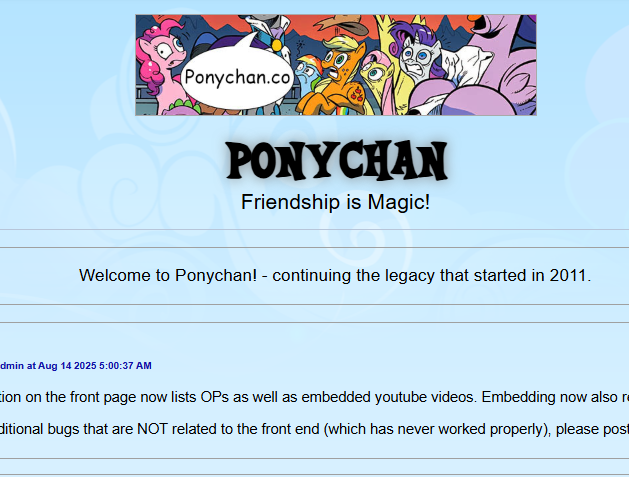
Ponychan (ponychan.co) is the primary successor and revival project of the original Ponychan.net, which was one of the most influential and historic hubs of the early "Brony" fandom. 1. Key Dates and Registration Original Site (ponychan.net) Launch: January 2011. It was founded as a dedicated space for My Little Pony: Friendship Is Magic fans who were being banned or restricted on 4chan. Revival (ponychan.co) Context: The original .net domain suffered a long decline due to administrative friction, culminating in a major fracture in 2021. After the original site staff effectively "salted the earth" and shut down the primary archives, the community splintered into several sites. ponychan.co emerged as the most prominent surviving "lifeboat" for the community. Current Status: While the fandom has largely moved to sites like Derpibooru or Discord, ponychan.co remains active as a legacy space for those who prefer the traditional imageboard format. 2. What is the site? Ponychan is an anonymous imageboard designed specifically for the My Little Pony fandom. The "Safe Haven" Philosophy: Unlike the often-toxic /mlp/ board on 4chan, the original Ponychan (and its successors) was founded with a much stricter focus on "love and tolerance." It traditionally enforced "Safe for Work" (SFW) rules and prioritized community building over the aggressive shitposting typical of other chans. Community Features: Historically, it was famous for hosting Q&As with show creators (like Lauren Faust) and being the birthplace of many early fandom memes and fanfiction trends. The Current Vibe: Today, it acts as a "Small Web" project, catering to long-term fans (often called "oldfags") who discuss the show's legacy, new generation (G5) updates, and personal life in a "comfy" environment. 3. What does the name mean? Pony: Refers to the My Little Pony franchise. Chan: The standard suffix for imageboards, derived from 2channel and 4chan. Ponychan: Effectively translates to "The Imageboard for Ponies." It was one of the first "boutique" chans to prove that a single-fandom imageboard could sustain a massive, dedicated population. 4. History and Context Ponychan's history is a microcosm of the Brony fandom's trajectory: from the "Ponypocalypse" (the mass migration from 4chan in 2011) to the "Ponynanza" (peak popularity 2012–2014) and the eventual "Great Fracture" of 2021. The .co domain represents the community's refusal to let its history die, even after the loss of their original .net home.

Continue ReadingPonychan

Sidson City

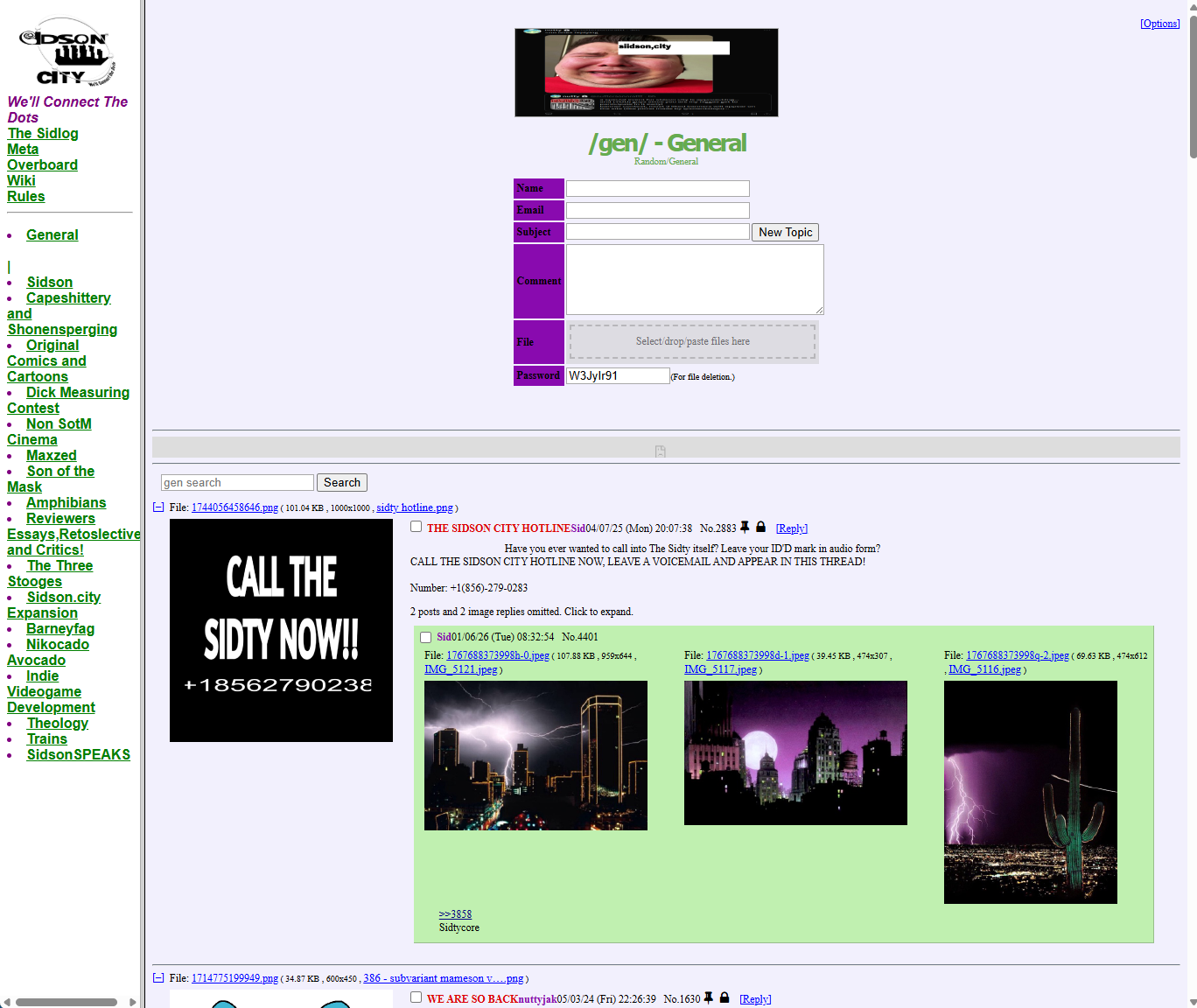
Sidson City (often referred to as The Sidty) is a niche, personality-driven imageboard and "Small Web" community that acts as a specialized offshoot of the "Soyjak" and "Maskposting" subcultures. It is heavily centered around the creative output and lore of its founder, an administrator known as Sid. 1. Key Dates and Registration Domain Registration: The domain sidson.city was registered in early 2024 (likely February or March). Launch: The site officially launched in early 2024. A post by a user named nuttyjak on May 3, 2024, explicitly notes that "this site is still pretty new." Wayback Machine: The first captures of the site appeared in mid-2024, shortly after the site gained traction within the "Sharty" (Soyjak.party) and "Sneed" communities. 2. What is the site? Sidson City is an anonymous imageboard (utilizing the Tinyboard/Vichan engine) that positions itself as a "refined" alternative to more chaotic boards like Soyjak.party. It is defined by its specific, often surreal, interests: The Focus: The site is the primary hub for Maskposting—a subculture dedicated to the 2005 film Son of the Mask (SotM) and its protagonist, Tim Avery. It treats the film with a mix of genuine obsession and deep irony. The "Sidjak" Aesthetic: The site features original "Sidjak" variants (MS Paint-style edits of the owner, Sid) and promotes original comics, cartoons, and indie game development. Community Standards: The site has a "no anime" rule (with minor exceptions) and encourages users to keep "jakking" (posting standard Soyjaks) to a minimum to maintain a unique identity separate from "The Sharty." Terminology: The community uses unique lingo, such as "ID'd" (equivalent to "Good" or "Gem") and "IV'd" (equivalent to "Bad" or "Coal"). 3. What does the name mean? Sidson: This is a combination of the administrator’s handle, Sid, and the suffix -son (possibly a play on "Sid's Son" or a reference to the film Son of the Mask). City: Implies a sprawling, multi-faceted community hub. The Sidty: The common portmanteau for the site, used by residents (referred to as Sidsonites or Sidsonians). "We'll Connect The Dots": The site's motto, which refers to the schizo-analytical and lore-heavy nature of the community's discussions. 4. History and Context The site emerged from the "Sneed/Mask wars of 2019" that took place on boards like /tv/ and later on specialized Soyjak boards. Sidson City was created to give these "MaskChads" and "Sid-loyalists" a permanent home. It also hosts a dedicated wiki (Sidson Wiki or the "Free Ensidclopedia") that documents the complex history of their digital raids and internal memes. image from 1-2026

Continue ReadingSidson City

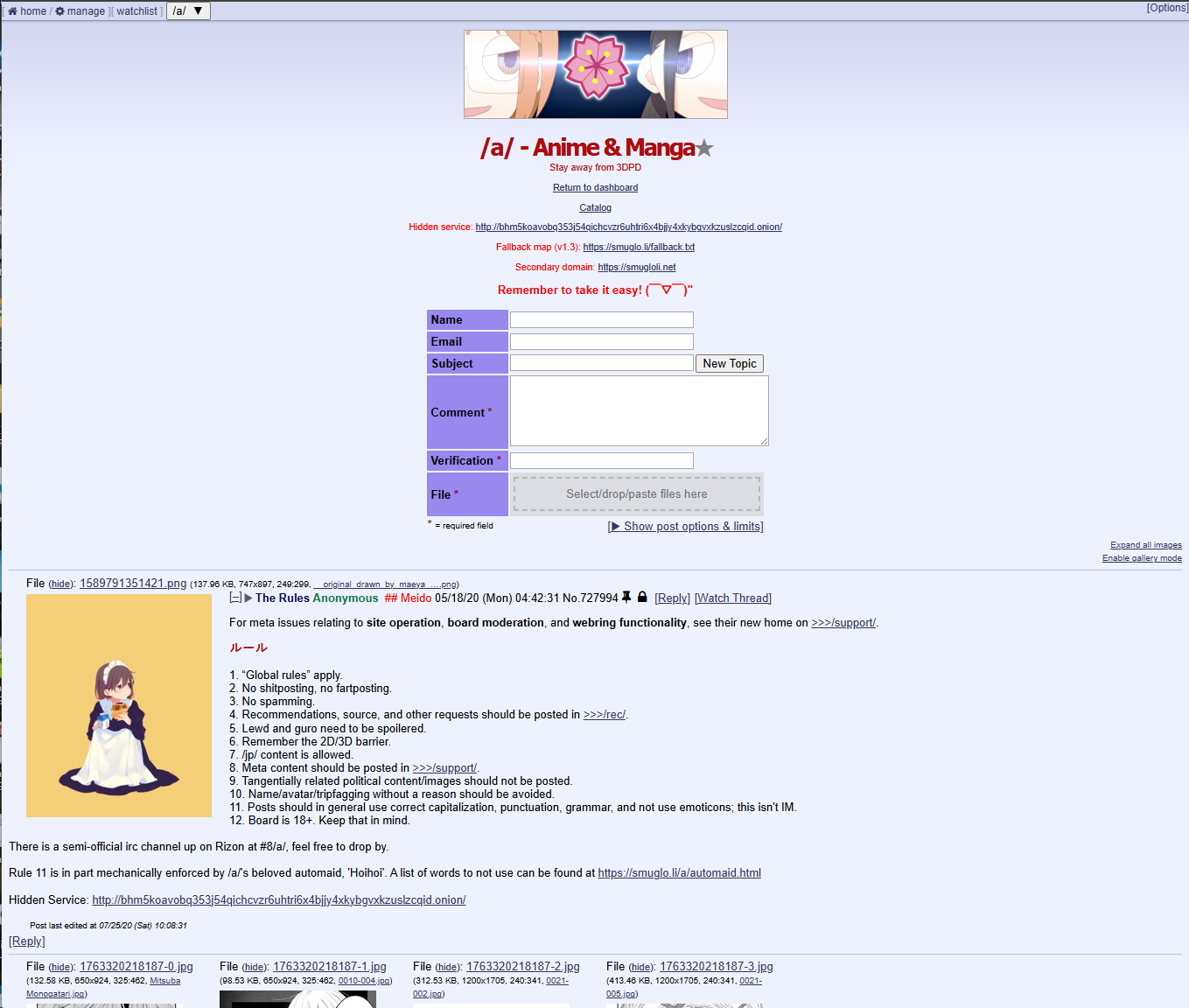
Smugloli

Smuglo.li (often stylized as SmugLo) is a niche internet project that gained notoriety in the mid-2010s as a "free speech" instance within the fediverse (specifically GNU Social and later Pleroma) while also hosting a dedicated imageboard component. 1. Key Dates and Registration Domain Registration: The domain smuglo.li was first registered on October 25, 2016. First Wayback Machine Capture: The Internet Archive first captured a snapshot of the site on January 4, 2017. Launch: The site launched in late 2016. It quickly became a focal point in the "Mastodon/Fediverse wars" of early 2017. Due to its extremely permissive moderation policies regarding "Red-tribe" (right-leaning) politics and controversial anime content, it was one of the first major instances to be "defederated" (blocked) by the larger, "safe-speech" Mastodon network. 2. What is the site? Smuglo.li was a hybrid social platform that combined a microblogging feed with a traditional imageboard. The Fediverse Instance: It began as a GNU Social instance, serving as a hub for users who were banned from or dissatisfied with mainstream Mastodon instances. It was known for a "troll-friendly" culture and a focus on absolute free speech. The Imageboard (/a/): The site hosted an imageboard (specifically at smuglo.li/a/) using the LynxChan engine. This board was primarily dedicated to anime discussion, but like many "alt-chans," it allowed for much more unrestricted discourse than boards like 4chan. Current Status: The site is largely considered a "legacy" instance today. By 2018–2019, it was often cited as a demo site for the catamphetamine/imageboard software and other open-source BBS projects, rather than a high-traffic community. 3. What does the name mean? The name is a portmanteau reflecting the site's primary aesthetic and technical origins: Smug: Refers to the "Smug Loli" internet meme—a specific anime character trope (often depicted as a young girl with a self-satisfied or mocking expression). This mascot was used extensively in the site's branding. Lo: Originally a reference to Local.li (a common GNU Social naming convention) or GNU Social (the "Lo" from the localized social feed). li: The country code top-level domain (ccTLD) for Liechtenstein, which was a popular choice for "free speech" sites in that era due to perceived jurisdictional benefits. Smuglo.li: Effectively translates to "The Smug Loli Channel/Instance."

Continue ReadingSmugloli

Sushichan

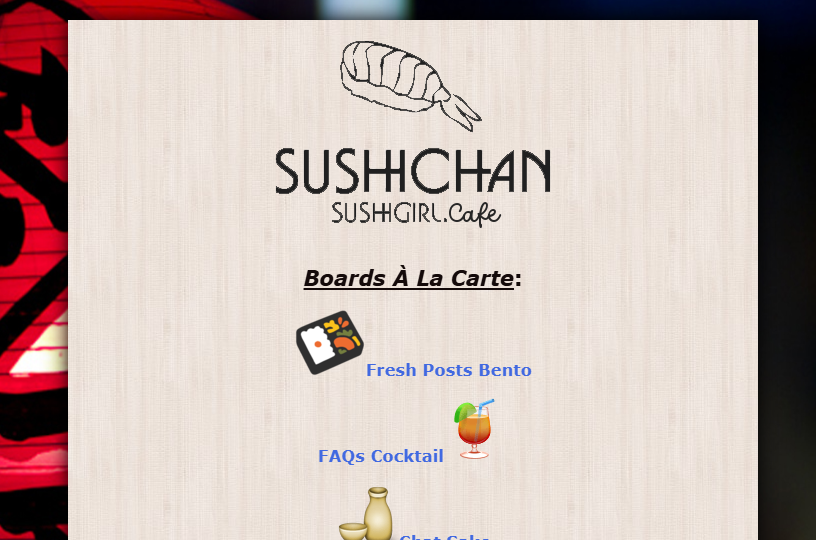
Sushigirl.cafe is a niche "Boutique Chan" and digital shrine dedicated to a specific internet personality and the broader aesthetic of "kawaii-core" and early 2010s internet nostalgia. 1. Key Dates and Registration Domain Registration: The domain sushigirl.cafe was registered on July 29, 2021. First Wayback Machine Capture: The Internet Archive first successfully crawled the site on August 25, 2021. Launch: The site launched in August 2021. It was created during a period when several specialized imageboards (often called "shrine boards") were emerging to celebrate specific e-celebrities or internet-famous models from the 4chan /b/ and /soc/ eras. 2. What is the site? The website is an anonymous imageboard and multimedia archive dedicated to the internet personality known as Sushi Girl (also known as "Sushi-Girl" or simply "Sushi"). The Subject: Sushi Girl was a prominent figure in the early-to-mid 2010s anonymous imageboard culture, known for her distinct look (often involving colorful hair, piercings, and a specific "alternative" or "scene" aesthetic). The Format: The site uses modern imageboard software (LynxChan or Vichan variants) but is designed to feel like a "Small Web" project. It acts as both a discussion forum and a permanent repository for photos, videos, and lore related to the persona. The Vibe: Unlike larger boards, it maintains a "comfy" and curated atmosphere. It is frequently associated with the "Webcore" and "Pinkcore" communities—subcultures that fetishize 2000s-era web design, pastel aesthetics, and early social media culture. 3. What does the name mean? Sushi Girl: This is the established online handle of the person the site is dedicated to. Cafe: In internet naming conventions (particularly those influenced by Japanese web culture like 2channel), the suffix "Cafe" or "Project" is often used to denote a specialized, community-run space that is intended to be more relaxed or hobby-focused than a general-purpose forum. Sushigirl.cafe: Effectively translates to "The Sushi Girl Community Space" or "The Sushi Girl Archive." 4. History and Community Context The site is part of the "Personality Chan" movement. In this corner of the internet, users who grew up on sites like 4chan or 7chan create dedicated "lifeboat" sites for their favorite figures. These sites serve as alternatives to mainstream platforms like Instagram or Twitter, which these users view as too corporate or over-moderated. While small, it maintains a very dedicated "loyalist" user base that tracks the history and updates of the persona. Images from 1-2026

Continue ReadingSushichan

Swfchan

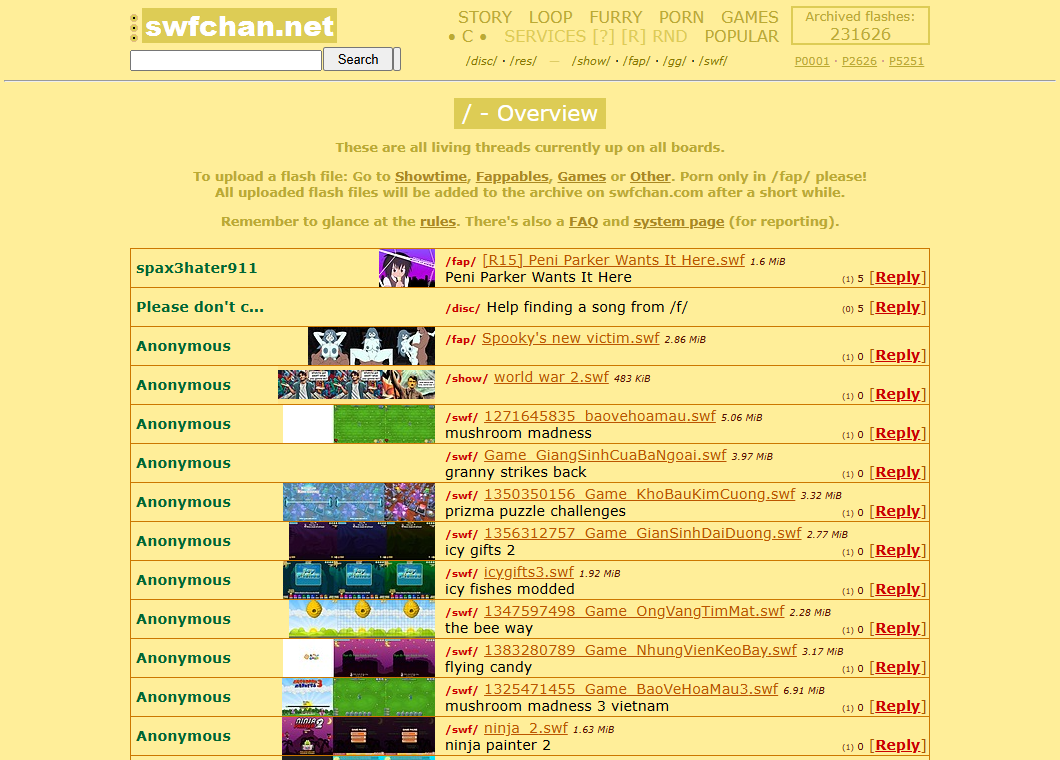
Swfchan (found at swfchan.net and boards.swfchan.net) is the internet's most comprehensive and long-standing archive for Flash animations, games, and loops. It serves as a permanent repository for files that would otherwise be lost due to the ephemeral nature of imageboards and the "death" of the Adobe Flash Player. 1. Key Dates and Registration Domain Registration: The primary domain swfchan.com was registered on April 14, 2007. The .net version, which often handles the technical board operations, followed shortly after. First Wayback Machine Capture: The Internet Archive first captured a snapshot of the site on April 28, 2007. Launch: The site launched in early 2007 as a companion to 4chan’s /f/ (Flash) board. While 4chan would delete files after a short period, Swfchan allowed users to upload and tag them permanently. 2. What is the site? Swfchan is essentially a community-curated library for .swf (Shockwave Flash) files. The Content: It contains everything from early 2000s viral animations (like Badger Badger Badger) to complex interactive games and "loop" animations set to music. It is a vital resource for digital historians and internet culture enthusiasts. The Technical Shift: Since the discontinuation of Adobe Flash in 2020, the site has integrated Ruffle, a Flash player emulator written in Rust. This allows modern browsers to play the archived files without needing original Flash plugins. The Boards: While the main site is a repository with a tag system, boards.swfchan.net is an anonymous imageboard where users discuss Flash preservation, request specific lost files, and share new discoveries. 3. What does the name mean? The name is a technical portmanteau: SWF: Stands for Shockwave Flash, the file format used by Adobe Flash for animations and games. Chan: The standard suffix for "Channel" or imageboard, indicating its roots in the anonymous forum culture of the late 2000s. Swfchan: Effectively translates to "The Flash File Imageboard." 4. History and Context Swfchan is considered one of the "Great Libraries" of the old web. Because Flash files were so integral to the "Golden Age" of memes (2005–2012), Swfchan is often the only place to find original, uncompressed versions of classic content. It has survived numerous legal challenges and technical hurdles, including a complete infrastructure overhaul to accommodate the post-Flash era. 1-2026 image

Continue ReadingSwfchan

22Chan

22Chan was made as an alternative to 4chan by people who were tired of the endless pornposting and low quality content. The current list of boards is below: /all/ - Overboard /a/ - Anime & Manga /b/ - Random /cre8/ - Art & Creativity /meta/ - Meta /mu/ - Music /server/ - Server /vg/ - Video Games /www/ - Internet History & Culture /yu/ - Feelings /sewers/ - Sewers /f/ - Flash /mp3/ - MPEG Audio Layer-3 News on 4/19/22, the owner is shutting down the site. Discussion on livechan sounds promising that it will be relaunched soon so I will keep it listed on AllChans for now. The /b/ is still working today. The rest look to be 404. screenshot of 22chan on 4/28/2022 Marking as dead 11-30-2022 It has been going to a cloudflare 404 page for a few weeks now. RE-added 5-5-23 screenshot above is from this date. 12-12-23 screenshot 5-4-2025 screenshot

Continue Reading22Chan